
 |
|

Toll-Free 1-888-484-9560
Store Locator | NOW HIRING FOR NY STORES


Trailer Hitches

|
|
|

Reese is the market leader in towing products and accessories for over 50 years. Reese uses technologically advanced equipment and testing that exceed industry standards, such as: computer aided design, fatigue testing, finite element analysis and advanced quality planning to guarantee a quality hitch to meet the challenges of your tow vehicle. Each Reese trailer hitch is custom fit to fit your vehicle. Reese produces various trailer hitches and hitch accessories including the aluminum trailer stabilizer jack, custom designed bolt on receiver style trailer hitches, adjustable trunnion style weight distributing systems, dual cam sway controls, removable fifth wheel hitches, sliding fifth wheel hitches, class IV trailer hitches and "install it yourself" multi fit trailer hitches.
A Reese Weight Distributing Hitch System is composed of four major elements:
-
Hitch receiver
-
Ball mount
-
Spring bar assembly
-
Sway control
These components work in unison to provide complete towing system compatibility.
There are four classes of Reese Trailer Hitches:
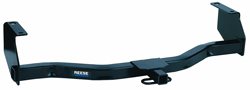
Class I Hitches
Class I hitches have the lowest Weight Carrying Gross Trailer Weight capacity (WCGTW) rating and tongue weight (WCTW) of the hitch classes and are generally used for small trailers carrying a motorcycle, snowmobile, ATV or Personal Watercraft or small 'pop-up' style campers or small 'U-Haul' style trailers. Class I hitches usually have a 1-1/4" square receiver opening and attach to your vehicle bumper, truck pan or frame. Sample vehicle: 2006 - 2008 Acura TSX
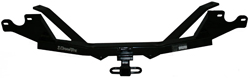
Class II Hitches
Class II hitches are Weight Carrying (WC) hitches rated up to 3500 lbs. Gross Trailer Weight (GTW) with a maximum trailer Tongue Weight (TW) of 300 lbs. This style of hitch typically uses a 1-1/4" square receiver opening. The use of a drawbar and hitch ball of the same rating or higher is required. Class II hitches normally attach to the vehicle frame and or bumper. Always consult your owner's manual for vehicle rating. Sample vehicle: 1995 - 2002 Cadillac Eldorado
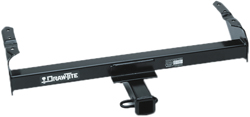
Class III Hitches
Class III hitches are Weight Carrying (WC) and also are Weight Distributing (WD) hitches depending on the vehicle and hitch specifications. Not all Class III hitches are rated to be both. Class III hitches used as Weight Carrying is rated up to 6,000 lbs. Gross Trailer Weight (GTW) with a maximum trailer Tongue Weight (TW) of 600 lbs. The use of a ball mount and hitch ball of the same rating or higher is required. To use the weight distribution side of the hitch a weight distribution system is required. Class III hitches attach to the vehicle frame only. Always consult your owner's manual for vehicle rating. Sample vehicle: 2003 - 2008 Honda Pilot
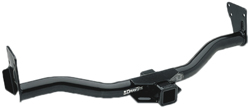
Class IV Hitches
Class IV hitches are Weight Carrying (WC) and Weight Distributing (WD) hitches depending on the vehicle and hitch specifications. Class IV hitches used as Weight Carrying are rated up to 10,000 lbs. Gross Trailer Weight (WCGTW) with a maximum trailer Tongue Weight (WCTW) of 1,000 lbs. This style of hitch typically uses a 2" square receiver opening. The use of a ball mount and hitch ball of the same rating or higher is required for weight carrying. Sample vehicle: 2006 - 2008 Ford Explorer
Each vehicle, hitch, drawbar and ballmount have their own weight capacity ratings. Never tow more than the lowest capacity allowed for any of these components. Always consult your owner's manual for vehicle rating and hitch, drawbar and hitchball manufacturers instructions for maximum ratings.
additional components:
It takes a lot more than just the hitch to get you and your vehicle on the road to adventure. The receiver is just the first component necessary to hitch up and be on your way. Additional necessary components required to tow safely and effectively are items such as the hitch ball, the coupler, draw bar, pins, clips and safety chains. Other suggested accessories are:
-
Winches
-
Trailer Jacks
-
Hitch ball lube
-
Hitch pin locks
-
Coupler locks
-
Hitch ball covers
-
Trailer stands
-
Trailer lighting
-
Hitch box covers


"Quick and easy. No html errors" (7/22/21)
-"This is my first experience with Auto Barn. It has been a good experience so far and I look fwd to doing more business with Auto Barn as long as I continue to have as good of an experience as this one has been. Thanks" (7/21/22)
-"Was a good experience overall" (7/20/22)
-"Available product, easy order, quick shipping, and excellent product. Highly recommend Auto Barn, and this product!" (7/17/22)
-
View Items in Cart

 And Get An Instant Coupon Code
